If your dishwasher is not draining, start with the simple fixes: let an interrupted cycle finish or drain, clean the filter, and check that the sink, garbage disposal and drain hose aren’t blocked. These checks solve many standing-water problems without tools. If water still sits in the tub after a full cycle, or the pump hums without moving water, a part such as the drain pump may need a technician.
In this guide:
- How much water is normal
- How a dishwasher drains
- Safety and step-by-step fixes
- Causes at a glance
- Hard water in Edmonton
- Common mistakes
- When to call a technician
- FAQ
Is some water in the bottom normal?
Yes, a little. Most dishwashers keep some water in the sump, the recessed area under the filter where water collects before it’s pumped out. GE Appliances’ support article “Water in the Bottom of the Tub” says one to two cups (roughly 250 to 500 mL) is normal, and Bosch’s customer-service guidance uses the same “no more than two cups” rule.
GE adds that on its models with an Ultra Fine filter, water should stay in the sump area rather than cover the whole tub floor. A practical test for any brand:
- Probably normal: up to about two cups of clean water after a completed cycle.
- A drain problem: more than that, dirty or greasy water, a sour smell, or food grit left on dishes.
How a dishwasher drains
Dirty water passes through the filter into the sump. The drain pump pushes it through a check valve (a one-way flap that stops water flowing back) and out the drain hose to the sink drain or garbage disposal. To prevent backflow, the hose rises in a high loop under the counter or passes through an air gap, a small fitting on the sink or countertop. A blockage anywhere along that path leaves water in the tub. Washers work similarly, so many of the same checks appear in our guide to a washing machine that won’t drain.
Safety before you start
- Cut the power. Whirlpool’s product help advises switching off the dishwasher’s circuit breaker rather than relying on the control panel.
- Let hot water cool so it can’t scald you.
- Wear sturdy gloves. Broken glass and sharp bones often end up in the sump.
- Skip chemical drain cleaners. GE’s support article on drain cleaner says they should never be used in a dishwasher because they’re caustic and can damage rubber parts.
Step-by-step: how to fix a dishwasher that won’t drain
Work through these steps in order, quickest first.
1. Rule out an interrupted cycle
A power cut or a door opened mid-cycle can leave water behind. Many models have a Cancel or Cancel/Drain function, often a button held for a few seconds, that runs the drain pump; check your manual for the exact method. If the water drains and the next full cycle ends normally, you’re done.
2. Remove the water and clean the filter
With the power off, lay towels down, pull out the lower rack, and scoop the water out with a cup and sponge. Bosch notes that a blocked filter can stop the machine from pumping water out effectively. On many models, you twist the upper filter counterclockwise, lift it out, then remove any lower mesh filter. Rinse the parts under warm water with a soft brush and reinstall them exactly as the manual shows; Whirlpool warns that a poorly seated filter can let debris into the pump.
3. Check the sump for debris
With the filter out, look into the sump opening. Wearing gloves, remove any glass, fruit pits, labels or bones you can reach. Don’t poke with sharp tools or push anything deeper toward the pump.
4. Run the disposal and check the sink
If the dishwasher drains into a garbage disposal, run the disposal with water flowing to clear its inlet. Then, as Samsung’s support page suggests, run the kitchen tap for about 30 seconds. If the sink drains slowly too, the clog is probably in the household plumbing rather than the dishwasher.
5. New disposal? Check the knockout plug
A new disposal comes with a plastic knockout plug sealing its dishwasher inlet. GE and Whirlpool both list a plug left in place as a reason a dishwasher stops draining after a disposal is installed or replaced. Removing it means working inside the disposal with the power off, so leave it to the installer or a plumber if you’re unsure.
6. Inspect the drain hose, high loop and air gap
Look under the sink for a kinked, crushed or sagging hose. Samsung notes that a dishwasher pushed back onto its own drain hose is the most common cause of drain trouble right after installation. Compare the loop height with your installation guide: Whirlpool’s “Checking the Drain Loop Height” page calls for at least 20 inches (about 51 cm) above the floor, or an air gap, while GE specifies at least 32 inches (about 81 cm). If you have an air gap, GE recommends removing its cap and cleaning out debris.
In Canada, plumbing codes are adopted provincially; according to the Government of Alberta, the National Plumbing Code of Canada 2020 has applied in Alberta since April 1, 2023. If you’re unsure whether your kitchen needs an air gap, ask a licensed plumber.
7. Rule out suds from the wrong detergent
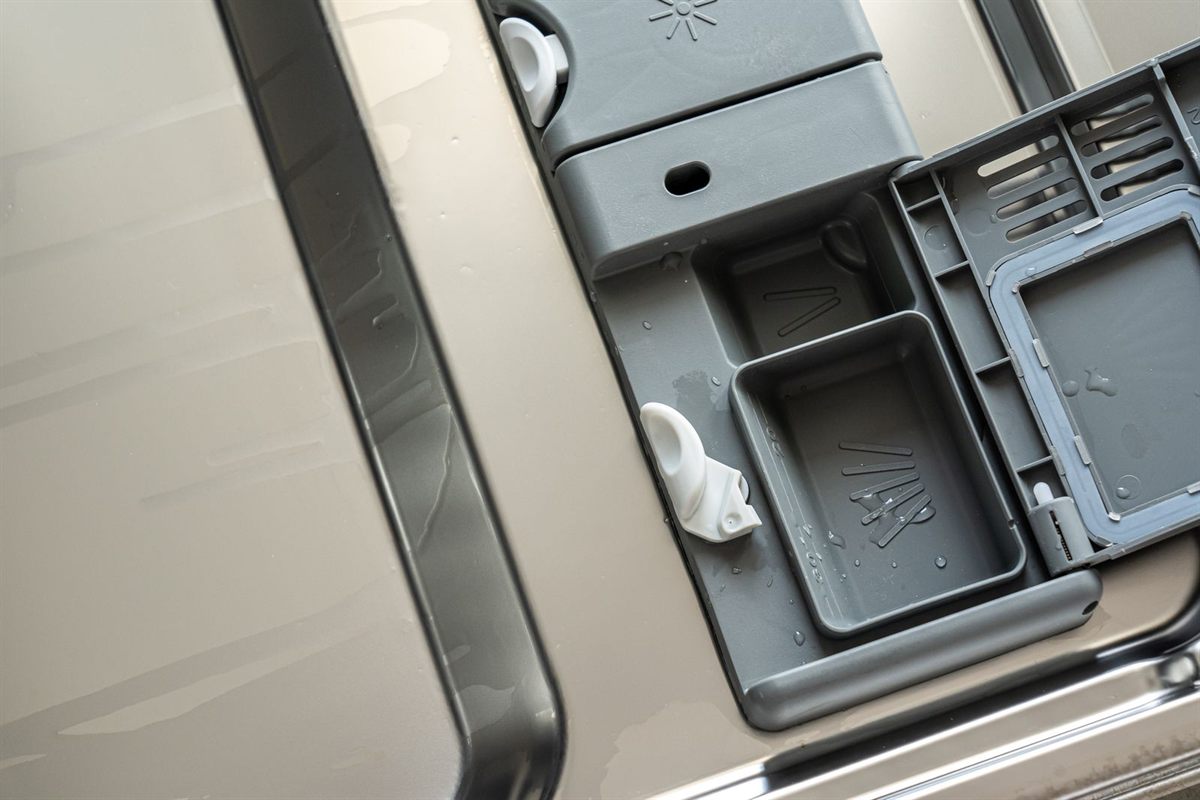
Hand dish soap foams heavily in a dishwasher, and GE warns that the wrong type or too much detergent can cause over-sudsing that stops proper draining. Whirlpool’s fix: cancel the cycle, clean up any overflow, remove the dishes, add about 1/4 cup of vegetable oil to the tub to calm the suds, and run a quick cycle with no detergent, repeating if needed.
8. Test the fix
Restore power and run a short rinse cycle, as Whirlpool suggests. Listen for the drain pump near the end, then check the tub. A cup or two of clean water is fine; more than that means the problem remains. Finish with a normal cycle and a regular load.
Causes at a glance
| Symptom | Likely cause | DIY check | Call a technician when |
|---|---|---|---|
| Water after a cycle stopped early | Interrupted cycle | Finish the cycle or use Cancel/Drain | It also happens after complete cycles |
| Murky water, gritty dishes | Clogged filter or sump | Rinse the filter, clear the sump | Water remains after cleaning |
| Sink drains slowly too | Sink or disposal clog | Run the disposal, test the sink | The sink stays blocked (call a plumber) |
| Started after a new disposal | Knockout plug left in | Check the disposal inlet | You can’t reach the plug safely |
| Dirty water returns after draining | Low hose, blocked air gap, worn check valve | Check loop height, clean the air gap | Routing is correct but backflow continues |
| Foam in the tub | Wrong or too much detergent | Cancel, remove suds, rinse | Draining doesn’t recover |
| Humming, grinding or silence at the drain stage | Jammed or failed drain pump | Check the sump for glass | The symptom continues |
| Drain error code | Blocked drain path or faulty part | Look up the code, do steps 1 to 7 | The code returns |
Does Edmonton’s hard water play a role?
Possibly, as a contributing factor. EPCOR’s Daily Water Quality page (checked in 2026) describes Edmonton’s river water as moderately hard, about 165 mg/L of calcium carbonate on average, or roughly 9.6 grains per gallon. Hardness doesn’t block a drain by itself, but mineral scale combined with grease can coat filters and the sump. Our practical conclusion: check the filter a little more often, use your dishwasher’s water-hardness setting if it has one, and descale as the manual recommends (Bosch, for example, suggests its descaler a few times a year).
Common mistakes to avoid
- Running cycle after cycle: each one adds water and raises the risk of a leak. Run one test, then find the cause.
- Reinstalling the filter loosely: debris can reach the pump. Lock it in as the manual shows.
- Using hand dish soap “just once”: the foam can stop draining and spill onto the floor. Keep only dishwasher detergent nearby.
- Sliding the dishwasher back without checking the hose: a pinched hose blocks draining. Make sure it’s free first.
When to call a technician
- More than a cup or two of water remains after you’ve cleaned the filter and checked the sink, disposal and hose.
- The drain pump hums, grinds or stays silent.
- Water drains, then flows back in, despite a correct loop or clear air gap.
- A drain error code keeps returning.
- You see water on the floor, smell burning, or the breaker trips.
Pumps, valves and wiring sit behind panels, and reaching them often means sliding the unit out. Our dishwasher repair service handles these faults, and the technician explains the repair and gives a clear estimate before work begins.
What affects the cost of a repair
Cost depends on the cause (clearing a clog usually takes less time than replacing a pump), parts availability for your brand and model, how hard the unit is to access, and its age and overall condition. Before you call, note the brand, model number and symptoms. If another appliance is acting up too, such as a refrigerator that isn’t cooling, run through its basic checks so you can describe both problems clearly.
Frequently asked questions
Is it normal for water to stay in the bottom of my dishwasher?
A small amount is. GE and Bosch both treat up to about two cups as normal. More than that, or dirty water, points to a drain problem.
Can I keep using the dishwasher with standing water in it?
One test cycle after cleaning the filter is reasonable. Repeated cycles with a blocked drain risk overflow and leaks.
Why won’t my dishwasher drain after a new garbage disposal was installed?
The knockout plug in the disposal’s dishwasher inlet was probably left in place. It must be removed before water can drain.
Why does dirty water come back into the tub after draining?
Usually the hose lacks a proper high loop or the air gap is blocked, so sink water flows back. A worn check valve can cause the same symptom.
Does my dishwasher need an air gap in Canada?
It depends on the plumbing code where you live and the installation instructions. GE and Whirlpool call for either a high loop or an air gap; a licensed plumber can confirm what your home needs.
How often should I clean the dishwasher filter?
Bosch recommends every few months, but follow your manual. Clean it sooner if you notice standing water, odours or gritty dishes.
How do I know if the drain pump has failed?
Humming, grinding or silence at the drain stage, once the filter, sump and hose are clear, points to the pump. Confirming it means testing parts behind the lower panel.
What does a drain error code mean?
Many brands flag drain faults with codes; Samsung, for example, lists 5C, 5E, OC and OE as drain-related. Look up your code in the manual and call a technician if it returns after the basic checks.
The bottom line
Start with the safe checks: the cycle, filter, sump, sink, disposal and hose. Then run a short test cycle. If more than a cup or two of water remains, or the pump hums or grinds, the fault is likely inside the machine.
If you’re in Edmonton, Sherwood Park, Spruce Grove or Acheson, you can book a dishwasher repair appointment online or call +1 (587) 501-7136. Dr. Appliance Fix offers same-day or flexible appointments, including Sundays, and many repairs are completed in the same visit, depending on the issue and parts availability.